Table of Contents
I used to treat negative comments almost like conversational assignments.
Someone handed me an opinion, and I felt like I had to do something with it.
Evaluate it. Respond to it. Correct it. Offer another perspective. Figure out whether it was fair.
But what if I don’t?
What if someone can say something negative, critical, pessimistic, or unnecessarily harsh—and I don’t have to pick it up and carry it forward?
That sounds simple enough when it’s a stranger or someone you barely know.
It can feel very different when it’s someone close to you. Someone you love, live with, or talk to several times a week—or every day.
Then you’re not dealing with one negative comment. You may be dealing with a pattern.
A lot of the time, I found myself staying quiet.
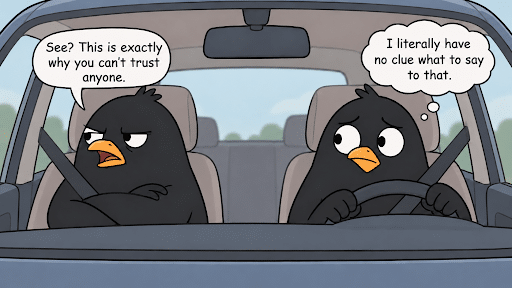
It wasn’t some empowered decision that I wasn’t going to give the negativity my energy. I just genuinely didn’t know what to say.
I didn’t agree with what was being said, but I also didn’t know how to push back without turning it into an argument.
Someone would make a negative comment about another person, assume the worst about someone’s intentions, or say something that felt unnecessarily harsh, and I would immediately start trying to figure out what I was supposed to do with it.
Do I challenge it?
Defend the other person?
Offer another explanation?
Say nothing and risk looking like I agree?
That last possibility was often the one that bothered me most. If I didn’t say anything, was I somehow participating anyway?
Sometimes I would let the comment pass in the moment, then think about it later and come up with all the responses I wish I had given.
That’s what made these conversations so draining for me.
The comment itself might only last a few seconds, but I could keep carrying it afterward.
Eventually, I started wondering whether I was focusing on the wrong problem. Maybe I didn’t need a better response to every negative comment. Maybe I needed to stop assuming every comment required a response from me in the first place.
If you’re trying to figure out how to handle a negative person, especially someone close to you, I’m starting to think the answer isn’t always confronting the negativity or convincing them to see things differently. Sometimes it’s learning how to stay in the relationship without automatically joining the direction of the conversation.
For me, that has started with five small shifts.
1. Let the Comment End With Them
Recently, someone close to me made a dismissive comment about another person.
It wasn’t a major argument. Just one of those small comments that lands wrong.
I didn’t respond at the time, but afterward I started thinking about all the responses I could have given. Maybe I should have defended the person or challenged the comment. I could have pointed out why I thought it was unfair.
For a while, I almost felt like I had missed my opportunity to do the right thing.
Then I started wondering why I thought I had to do anything at all.
I wasn’t agreeing. I just wasn’t continuing the conversation.
Those are not necessarily the same thing.
That distinction matters to me because silence can feel uncomfortable when you care about being fair. I don’t want someone to assume I agree with something simply because I didn’t challenge it. But I also don’t think every passing comment needs to become a debate just so I can establish my position.
I think I’ve often treated negative comments as if they require some kind of verdict from me. Agree or disagree. Approve or correct. Participate or confront.
But there may be another choice.
I can let the comment sit exactly where the other person put it.
I don’t have to ask a follow-up question. I don’t have to offer another example. I don’t have to prove that I see the situation differently.
Sometimes I can simply give the comment nowhere else to go.
2. Acknowledge Their Feelings Without Joining the Negativity
This one has been especially helpful when someone is telling me about something frustrating that happened to them.
Maybe someone ignored them, was rude to them, or did something they didn’t like.
Then the story starts growing.
“They did that because they’re arrogant.”
“They knew exactly what they were doing.”
“That’s just the kind of person they are.”
My instinct has often been to investigate.
How do you know they meant it that way? Maybe they didn’t hear you. Could there be another explanation?
But I’m realizing that this still keeps me inside the negative story. Now I’m analyzing a person I don’t know and debating motives I couldn’t possibly know for sure.
And sometimes, trying to offer the more generous interpretation doesn’t actually make the conversation less negative. It just turns the conversation into an argument about which interpretation is correct.
I can respond to something much simpler.
“That sounds frustrating.”
“I can see why that annoyed you.”
And leave the rest alone.
I don’t have to validate every conclusion someone draws in order to acknowledge that they had an irritating experience.
I like the distinction expert in relationship psychology, George Pransky makes between understanding someone and reacting to everything they are saying. Compassion doesn’t have to mean adopting the person’s interpretation or deciding their judgment is correct.
I can care that someone I love is upset without making their version of the situation my version too.
That has become a useful little distinction for me:
I can acknowledge the feeling without investigating the story.
That lets me stay connected to the person without becoming responsible for deciding whether every assumption they’ve made is true.
3. Redirect a Negative Conversation Without Starting an Argument
Sometimes I don’t want to leave a big silence, especially with someone I care about.
I also don’t want to turn the moment into a discussion about their negativity.
So I can just help the conversation move somewhere else.
“Anyway, I’m really looking forward to…”
“Oh, that reminds me…”
“You know what I’ve been meaning to tell you?”
The redirect doesn’t have to be obvious.
I’m not announcing, “We’re changing the subject now because you’re being negative.”
I’m simply giving us another place to go.
This is something I want to practice more because I’m realizing how easy it is for a negative conversation to keep going simply because nobody changes direction.
One complaint leads to another example. Then another person gets brought into it. Before long, something that started as one small irritation has become a much bigger mood.
I used to think the conversation kept going because the other person wanted to keep talking about it. Sometimes that’s probably true. But conversations also have momentum. If I keep asking questions, adding examples, or even arguing against each point, I may be helping the subject stay alive.
A gentle redirect gives the conversation another option.
And sometimes that’s enough.
Other times, though, changing the subject isn’t really the issue. The conversation may end, but I’m still thinking about it an hour later. That’s a different kind of involvement.
4. Stop Giving a Negative Person Space in Your Head
There are also times when I don’t necessarily need to redirect the conversation. I just want to be clear about where I’m putting my own attention.
That might sound like:
“I’m trying not to give that much attention.”
“I don’t really want to spend my energy on that.”
“I’d rather focus on what I can actually do something about.”
I’m not asking the other person to agree with me.
I’m also not trying to convince them that the thing they’re talking about isn’t negative, upsetting, or worth caring about.
I’m deciding what I want to keep thinking about.
That feels different.
When you talk to a negative person regularly, their way of seeing things can start taking up space in your mind even when you don’t agree with them.
That can be especially noticeable when you’re living with a negative person or talking to them every day. The conversation may be over, but you’re still carrying the atmosphere of it.
For me, a lot of that happens because I keep engaging after the conversation ends.
I replay the comment.
I think about why it was unfair.
I come up with a better response.
I keep having the conversation when the other person isn’t even there anymore.
I’m starting to see that protecting my attention may be just as important as what I actually say.
And that raised a bigger question for me. What if I keep needing to protect my attention from the same kind of conversation over and over again? At some point, the issue may be larger than any individual comment.
5. Change the Rhythm of the Relationship if You Need To
This is probably the bigger shift for me.
If I constantly have to manage where a conversation goes, maybe the answer isn’t only getting better at responding to each negative comment.
I may also need to notice the conditions under which I enjoy the relationship most.
There may be people I genuinely love but don’t need to talk to every single day.
Maybe I enjoy them more when we’re doing something together instead of sitting on the phone with unlimited time to fill.
Shorter conversations may work better.
Seeing each other once or twice a week might feel more connecting than talking constantly and repeatedly ending up somewhere I don’t want to go.
I used to think changing the rhythm of a relationship might mean I was pulling away from the person.
Now I’m seeing that it may be much more practical than that.
Not every relationship functions best with unlimited access. And reducing the amount of time available for certain conversational patterns doesn’t necessarily mean I love the person less.
It may simply be a way of protecting what I actually like about the relationship.
That feels particularly important because a lot of advice about how to deal with a negative person seems to focus on the moment of confrontation: what to say, how to shut the conversation down, how to establish a boundary.
Those things may sometimes be necessary. But sometimes the more useful change happens before the conversation even starts—in how often we talk, what we do together, and how much room I give a familiar pattern to develop.
You Don’t Have to Engage With Every Negative Comment
That’s what negative comments are beginning to feel like to me: invitations.
An invitation to judge someone, speculate about motives, complain, or spend the next several minutes thinking about something I wasn’t thinking about before.
I don’t have to accept every one.
Even when it comes from someone I love.
I can still listen and care about the person speaking. I can acknowledge that something was annoying or frustrating without following every interpretation that comes after it.
And I don’t necessarily have to choose between absorbing the negativity and shutting down the negative person. There is a lot of room in between those two options.
I’m learning that I can stay connected to someone without joining every conversation they want to have.
Maybe that’s the part I was missing when I kept searching for the right response. I thought my job was to figure out what to do with whatever someone handed me.
Someone close to me can hand me a negative thought.
I don’t have to turn it into an assignment.
Read More from Relationship Blackbook
Discover more from Relationship Blackbook
Subscribe to get the latest posts sent to your email.

Leave a Reply